.png)


Things Nobody Tells You About Going Full-Time as an Artist

Going full-time as an artist sounds dreamy until you realise how much of the job happens nowhere near the actual artwork.
I used to imagine it would mean long, slow mornings in the studio, paintbrush in hand, ideas arriving politely at the exact moment I needed them. There is some of that, thankfully. But there is also admin. So much admin.
My snail mail collection is finally ready for launch on 1 August 2026, and getting to this point has taught me a lot about the reality behind the romantic version of being a full-time artist. It is beautiful, yes. It is freeing, yes. It is also a lot more practical, repetitive, and mentally demanding than people tend to say out loud.

The admin is a whole job before the art even begins
Nobody warns you properly about the admin.
They might mention tax returns or emails in passing, but they do not always talk about the daily tasks that quietly eat into your creative time. Booking shipments. Weighing parcels. Checking addresses. Updating listings. Writing product descriptions. Making sure the right thing is marked as sold out. Uploading files. Replying to customer questions. Tracking orders. Reordering packaging before you run out.
Then there are the photos.
Taking images of work sounds simple until you are trying to make a piece look professional without making it look fake. You need decent light, clean backgrounds, accurate colours, straight edges, and enough detail for someone to feel confident buying it online. Then comes editing.
Sometimes that means adjusting the crop or brightness. Sometimes it means photoshopping out a speck of dust, a shadow, or a tiny imperfection from the background that has nothing to do with the artwork itself. It is not about misrepresenting the piece. It is about presenting it clearly, in the way it deserves to be seen.
And by the time you have done all of that, you can feel like you have already worked a full day before even touching a paintbrush.
That was one of the biggest shocks for me. Going full-time did not remove the “work” part. It just changed what the work looked like.
Routine matters more than motivation
I used to think creativity needed freedom from structure. I thought a routine would make the whole thing feel stiff or forced.
I was wrong.
What I actually needed was a routine that worked with my life, not against it. Not some perfect, aesthetic schedule that looks good written in a notebook. A real routine. One that allows for slow mornings, missed starts, admin-heavy days, and the natural ups and downs of creative energy.
For me, routine has become less about control and more about support. It removes some of the constant decision-making. I do not have to wake up and ask, “What should I do first?” every single day. I already know roughly where things go.
A good routine might look like:
Packing orders in the morning while my brain warms up
Photographing work on the brightest days
Saving listing updates for one focused block of time
Keeping painting time protected where possible
Doing a quick studio reset before finishing for the day
The routine is not there to trap the creativity. It is there to make room for it.

Motivation is lovely when it shows up, but routine is what catches you when it does not.
Artist block can hit hardest when you finally have time
This one caught me completely off guard.
When I still had another job, ideas seemed to arrive constantly. I would be doing something totally unrelated and suddenly think of a colour palette, a character, a phrase, a theme, a little collection idea. I would tell myself, “When I have more time, I will make all of this.”
Then I went full-time.
Suddenly, I had the time I had been craving. And my brain went quiet.
It was so frustrating. All those ideas I had while juggling employment, errands, and exhaustion seemed to disappear the moment I had space for them. I think part of it was pressure. When art becomes your main work, every blank page can start to feel heavier. You are not just playing anymore. You are trying to make something that can exist in the world, be shared, maybe even be sold.
That pressure can drain the joy out of making if you let it.
What has helped me most is keeping notes while I am out living my actual life. Not only when I am sitting in the studio waiting for inspiration to behave.
I write down tiny things:
A colour combination I see on a walk
A sentence someone says that sparks an idea
A shape, texture, or pattern I want to remember
A feeling I want to turn into a piece
A future collection name that appears at a random time
Some notes are messy. Some make no sense later. Some become nothing. But they give future me somewhere to dig.
Artist block feels less frightening when there is a little archive of breadcrumbs waiting for you.
A messy space really can make a messy brain
I wish this were not true for me, but it is.
A chaotic studio makes my head feel chaotic. If my desk is covered in old cups, packaging scraps, half-used materials, notes, orders, and paint water that should have been changed two days ago, I cannot settle. I might still make something, but it feels harder than it needs to.
The closest comparison I have is cooking in a dirty kitchen. You technically can do it, but every step feels annoying. You cannot find the knife. The surface is sticky. The pan you need is still in the sink. Before long, the simple act of making food feels like a personal attack.
Painting in a messy space feels the same.
I do not need the studio to be spotless. I am not aiming for a showroom. It is a working space, so of course it gets used. But everything needs a place. Paints go there. Packaging goes there. Prints go there. Current projects have a spot. Finished pieces have a spot. Random scraps either become useful or get cleared.
That little bit of order gives my mind one less thing to fight.
Tidying is not separate from the creative work for me anymore. It is part of preparing to create.
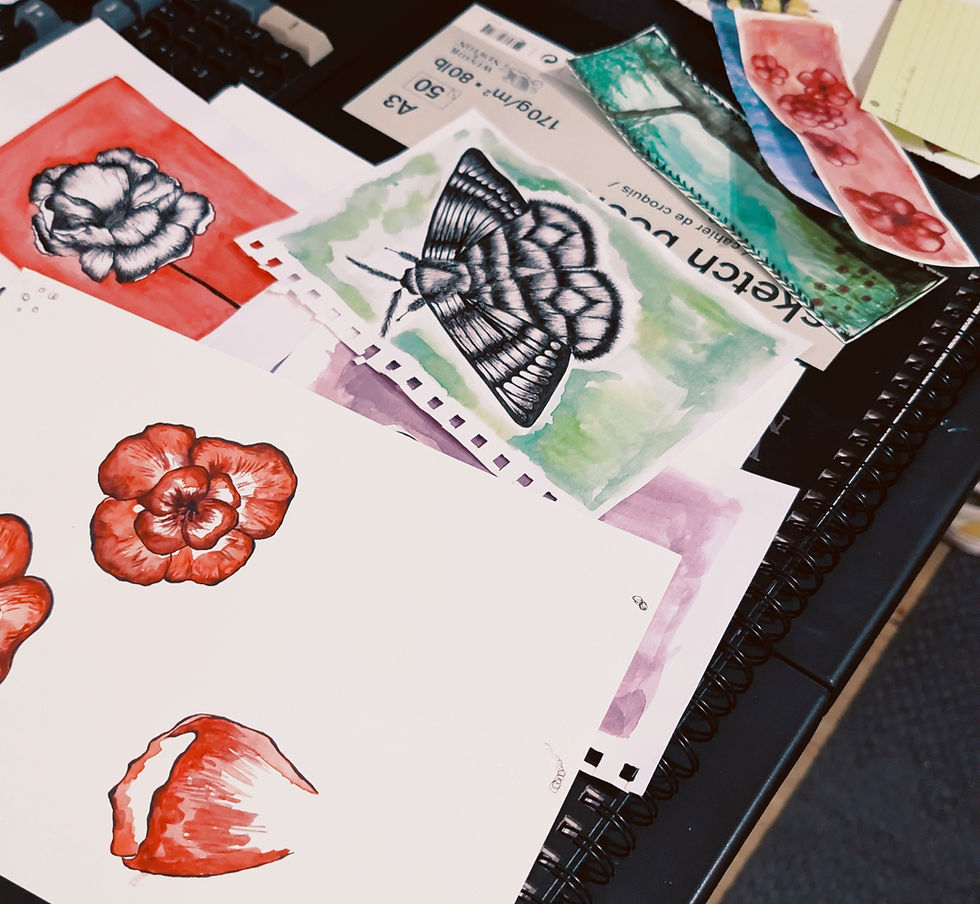
The panic spiral is real, so slowing down matters
There was a point where I realised I had recreated the exact feeling I left my old job to escape.
My to-do lists were stacking up. I was overworking. I felt behind even when I had been working all day. Every task created three more tasks. Launch planning, listings, photos, packaging, emails, sketches, painting, cleaning, posting, ordering supplies. The whole thing started to feel less like freedom and more like a panic spiral with prettier stationery.
That was a strange moment. Because I love this. I really do. But loving something does not mean you cannot burn out from it.
I had to give myself permission to slow down.
Not quit. Not stop caring. Just slow down enough to remember why I wanted this in the first place.
When I stopped trying to force myself into constant output, the curiosity came back. I started noticing ideas again. I felt more playful. The work felt less like proof that I was doing enough and more like something I was allowed to enjoy.
That is the balance I keep coming back to.
Yes, take the work seriously. Build the shop. Book the shipments. Edit the photos. Keep the listings updated. Create the routine. Tidy the studio. Do the unglamorous bits.
But do not squeeze all the joy out of the thing you worked so hard to choose.
Going full-time as an artist is not just about making art all day. It is about learning how to hold the creative, practical, emotional, and ordinary parts together without losing yourself in the process.
And above all, it is meant to be fun.
Not every second. Not every task. Definitely not every shipping label.
But the journey itself should still have joy in it. Let it be balanced. Let it be slower when it needs to be. Let it change shape as you do. The art will be better for it, and so will you.


Comments